Choosing the right oxygen equipment can be an important decision for patients who require supplemental oxygen at home. Two of the most commonly used options are oxygen concentrators and oxygen cylinders. While both can provide supplemental oxygen, they work differently and have different advantages, limitations, costs, and practical considerations.
So, which is better: an oxygen concentrator or an oxygen cylinder?
The answer depends on factors such as the patient’s prescribed oxygen flow rate, duration of use, mobility, electricity availability, emergency requirements, and whether oxygen is needed temporarily or for an extended period.
In this guide, we compare an oxygen concentrator vs oxygen cylinder in detail to help patients and caregivers understand the differences and make a more informed decision.
What Is an Oxygen Concentrator?
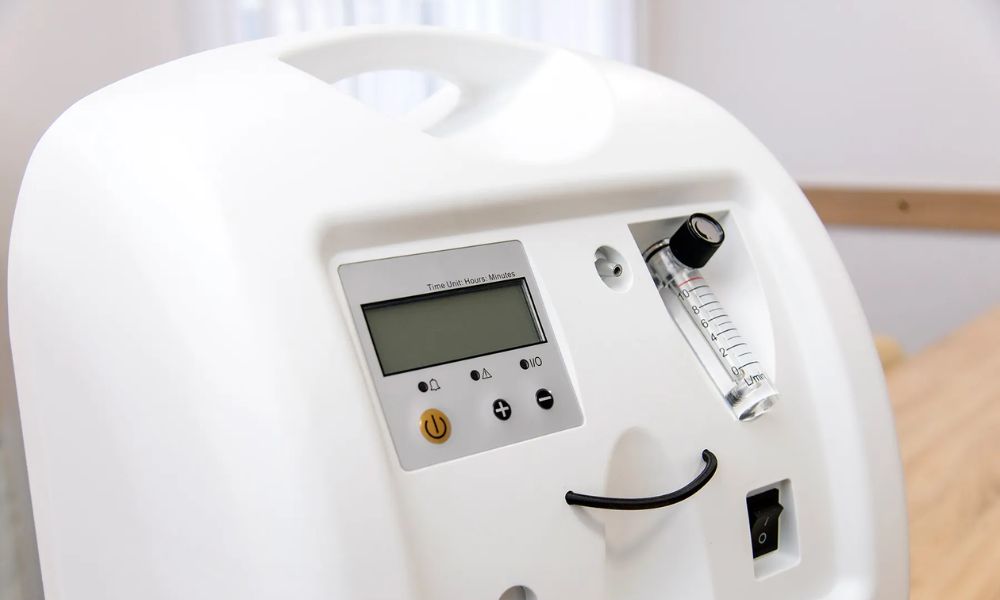
An oxygen concentrator is a medical device that takes air from the surrounding environment, removes most of the nitrogen and other gases, and delivers concentrated oxygen to the user.
Unlike an oxygen cylinder, a concentrator does not store a fixed amount of oxygen inside a tank. Instead, it continuously produces concentrated oxygen while the machine is operating.
Most home oxygen concentrators require electricity to operate. They are available in different capacities, including commonly used 5 LPM and 10 LPM oxygen concentrators.
How Does an Oxygen Concentrator Work?
An oxygen concentrator generally works through the following process:
- The machine draws in room air.
- The air passes through filters.
- Molecular sieve beds separate nitrogen from oxygen.
- Concentrated oxygen is delivered through oxygen tubing.
- The process continues while the machine is powered on.
This makes concentrators particularly useful for people who require oxygen for extended periods.
What Is an Oxygen Cylinder?
An oxygen cylinder is a pressurized container filled with medical oxygen. Unlike a concentrator, a cylinder stores a predetermined quantity of oxygen.
The oxygen is delivered through a regulator and flow-control system. Once the oxygen inside the cylinder is depleted, the cylinder needs to be refilled or replaced.
Oxygen cylinders are available in different sizes, making them useful for home use, transportation, and emergency backup situations.
How Does an Oxygen Cylinder Work?
The basic process is straightforward:
- Medical oxygen is stored under pressure inside the cylinder.
- A regulator controls the pressure.
- The prescribed oxygen flow is selected.
- Oxygen travels through tubing to the patient.
- The cylinder eventually needs to be refilled or replaced.
Because cylinders contain stored oxygen, they can continue supplying oxygen without electricity.
Oxygen Concentrator vs Oxygen Cylinder: Key Differences
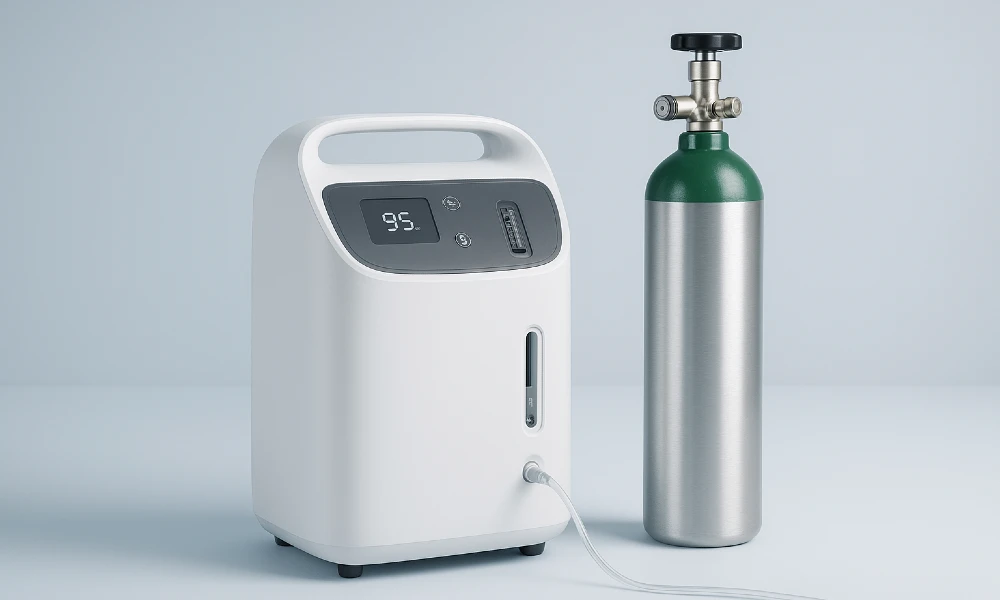
The following comparison highlights some of the major differences between the two options:
| Feature | Oxygen Concentrator | Oxygen Cylinder |
|---|---|---|
| Oxygen Source | Concentrates oxygen from room air | Stores compressed oxygen |
| Electricity | Required | Not required during use |
| Refilling | Not required | Required after oxygen is used |
| Continuous Operation | Can operate while powered | Limited by stored oxygen |
| Power Cut Dependency | Yes | No |
| Storage | No oxygen storage tank | Requires secure cylinder storage |
| Portability | Depends on model | Depends on cylinder size |
| Long-Term Use | Often convenient | Requires regular refilling |
| Emergency Backup | Limited during power failure | Useful as backup |
| Maintenance | Filter and device maintenance | Cylinder, regulator and equipment checks |
| Travel Convenience | Portable models available | Can be heavier and require handling |
| Running Cost | Electricity and maintenance | Oxygen refilling/replacement costs |
The best choice depends on the patient’s individual oxygen requirements and circumstances.
Advantages of an Oxygen Concentrator
Oxygen concentrators have become popular for home oxygen therapy because they can provide a continuous oxygen supply as long as electricity is available.
1. No Regular Oxygen Refilling
One of the biggest advantages is that concentrators do not require regular oxygen refilling. The machine uses surrounding air and concentrates the oxygen from it.
This can be convenient for people who need oxygen regularly.
2. Suitable for Long-Term Home Use
For patients who have been prescribed oxygen for extended periods, a concentrator can be a practical option because there is no need to repeatedly arrange cylinder refills.
3. Continuous Oxygen Production
A concentrator can continue producing concentrated oxygen while it is operating and receiving electricity.
This can make it useful for extended periods of use.
4. No Large Oxygen Storage Requirement
Unlike cylinders, concentrators do not require storage of compressed oxygen. This can reduce the need to manage multiple filled cylinders.
5. Different Models Are Available
There are stationary and portable oxygen concentrators available for different needs.
Some home-use machines are designed for higher oxygen output, while portable models are designed to make movement easier.
Disadvantages of an Oxygen Concentrator
Despite their advantages, oxygen concentrators also have limitations.
1. Requires Electricity
The most important limitation is that an oxygen concentrator generally needs electricity to operate.
During a power outage, the machine cannot continue functioning unless an appropriate backup power solution is available.
2. Not Every Concentrator Provides the Same Flow
Different concentrators have different output capabilities. A 5 LPM model and a 10 LPM model are not interchangeable for every patient.
The required oxygen flow should be determined by a healthcare professional.
3. Requires Regular Maintenance
Filters, tubing, and other components need to be maintained according to the manufacturer’s instructions.
Poor maintenance can affect device performance.
4. May Be Less Suitable for Some Emergency Situations
If there is a power failure and no suitable backup is available, relying solely on a concentrator can create a problem for someone who has an ongoing prescribed oxygen requirement.
For this reason, some households maintain a cylinder as an emergency backup.
Advantages of an Oxygen Cylinder
Oxygen cylinders remain widely used because they offer several practical benefits.
1. Works Without Electricity
An oxygen cylinder does not need electricity to deliver oxygen.
This makes it particularly useful during power cuts and certain emergencies.
2. Useful as an Emergency Backup
A cylinder can provide an alternative oxygen source if a concentrator stops working or electricity becomes unavailable.
3. Portable Options Are Available
Smaller cylinders can be easier to transport than large cylinders, depending on their size and the user’s circumstances.
4. Immediate Stored Oxygen
Because oxygen is already stored inside the cylinder, it is available for use without waiting for the device to generate or concentrate oxygen.
Disadvantages of an Oxygen Cylinder
1. Oxygen Supply Is Limited
A cylinder contains a fixed amount of oxygen. Once the available oxygen is used, the cylinder needs to be refilled or replaced.
2. Refilling Is Required
People who depend on cylinders for regular oxygen therapy need to plan for refilling or replacement.
3. Storage Requires Care
Oxygen cylinders need to be stored securely and handled properly.
They should be kept away from heat, flames, and smoking materials.
4. Transportation Can Be Difficult
Larger oxygen cylinders can be heavy and may be inconvenient to move frequently.
5. Ongoing Refilling Costs
For long-term use, the cost and logistics of repeated refilling can become an important consideration.
Which Is Better for Home Use?
There is no single answer to whether an oxygen concentrator or cylinder is better for home use.
The right option depends on the patient’s prescribed oxygen requirement and circumstances.
An Oxygen Concentrator May Be a Better Choice When:
- Oxygen is required regularly for an extended period.
- Electricity is consistently available.
- The user wants to avoid frequent cylinder refilling.
- The equipment will primarily be used at home.
- A suitable concentrator matches the prescribed oxygen requirement.
An Oxygen Cylinder May Be More Useful When:
- Electricity is unavailable or unreliable.
- Immediate stored oxygen is required.
- The cylinder is being used as an emergency backup.
- Oxygen is needed temporarily.
- A healthcare professional has recommended cylinder-based oxygen delivery.
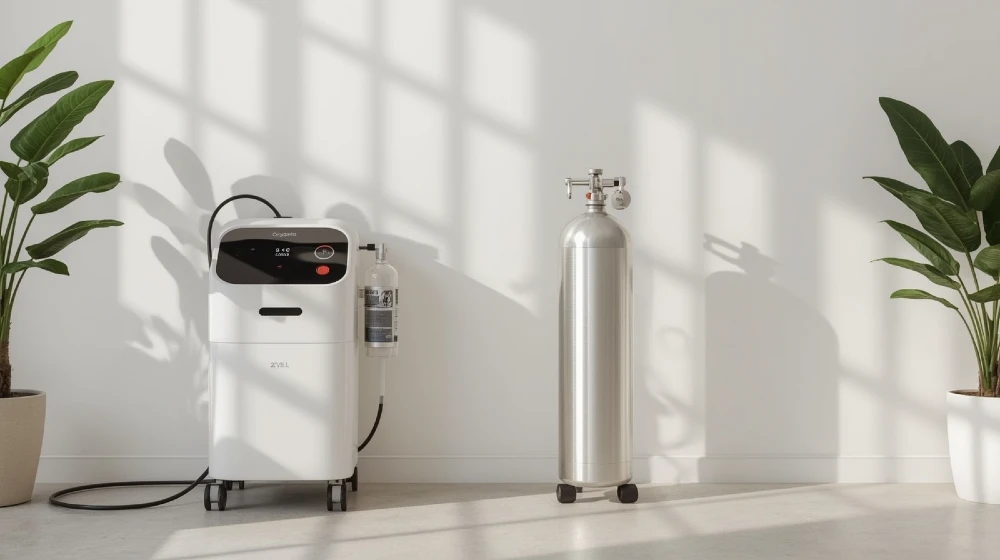
In many situations, households may use a concentrator as the primary oxygen source and keep an appropriate oxygen cylinder available as a backup. Whether this arrangement is suitable depends on the patient’s medical needs.
Oxygen Concentrator vs Oxygen Cylinder for Long-Term Use
For long-term oxygen therapy, convenience becomes an important factor.
An oxygen concentrator can be convenient because it continuously concentrates oxygen from room air and does not need to be refilled like a cylinder.
However, electricity availability becomes an important consideration.
A person who depends on oxygen continuously should have an appropriate contingency plan for power failures. A backup oxygen source may be recommended by the healthcare team depending on the situation.
The important point is not simply choosing the cheapest option but ensuring that the oxygen delivery system can reliably meet the prescribed requirement.
Oxygen Concentrator vs Oxygen Cylinder During a Power Cut
Power availability is one of the biggest differences between the two systems.
An oxygen concentrator normally requires electricity. Therefore, during a power outage, it may stop operating.
An oxygen cylinder, on the other hand, does not require electricity during oxygen delivery.
For patients who depend on supplemental oxygen, families should plan ahead for possible power interruptions.
Possible backup arrangements may include:
- A properly maintained oxygen cylinder.
- A suitable backup power system for compatible equipment.
- Emergency contact information for oxygen suppliers.
- Fully charged portable equipment where medically appropriate.
- Regular checking of oxygen equipment.
Never wait until a power failure occurs to determine what the backup plan should be.
5 LPM vs 10 LPM Oxygen Concentrator
Oxygen concentrators are available in different output capacities. 5 LPM and 10 LPM oxygen concentrators are common examples.
LPM means litres per minute, referring to the oxygen flow rate delivered by the equipment.
However, a higher LPM does not automatically mean that a 10 LPM machine is better for every patient.
The appropriate flow rate depends on the individual’s medical condition and prescription.
5 LPM Oxygen Concentrator
A 5 LPM concentrator may be suitable for patients whose prescribed oxygen requirement falls within the device’s capabilities.
10 LPM Oxygen Concentrator
A 10 LPM concentrator is designed for situations where a higher oxygen flow may be prescribed.
The required flow should always be determined by a qualified healthcare professional.
Do not increase oxygen flow simply because a higher-capacity machine is available.
Oxygen Concentrator vs Oxygen Cylinder: Cost Considerations
Cost is another important factor when choosing oxygen equipment.
Instead of looking only at the purchase price, consider the total cost of using the equipment.
Oxygen Concentrator Costs May Include:
- Purchase or rental cost
- Electricity consumption
- Maintenance
- Filter replacement
- Repairs
- Backup arrangements
Oxygen Cylinder Costs May Include:
- Purchase or rental cost
- Oxygen refilling
- Cylinder transportation
- Regulator and accessories
- Maintenance and safety checks
- Replacement costs
For occasional or short-term requirements, renting equipment may be practical. For long-term use, purchasing an appropriate device may be worth considering.
Actual costs vary depending on equipment type, location, supplier, rental period, oxygen requirements, and other factors.
Can You Rent an Oxygen Concentrator or Oxygen Cylinder?
Yes, oxygen equipment may be available for rental depending on the supplier and location.
Oxygen concentrator rental can be useful when oxygen support is required temporarily, such as during recovery at home.
Similarly, oxygen cylinder rental can provide a temporary oxygen source or backup option.
Before renting equipment, check:
- Equipment capacity
- Condition of the machine or cylinder
- Included accessories
- Delivery availability
- Installation or demonstration support
- Maintenance policy
- Rental duration
- Replacement or emergency support
Always ensure that the equipment matches the oxygen prescription provided by the healthcare professional.
Safety Tips for Using Oxygen at Home
Oxygen supports combustion, so proper safety precautions are extremely important.
Keep Oxygen Away From Flames
Never smoke or use open flames near oxygen equipment.
Keep oxygen equipment away from:
- Cigarettes
- Gas stoves
- Candles
- Incense
- Fireplaces
- Sparks
- Other ignition sources
Follow the Prescribed Oxygen Flow
Use the oxygen flow rate prescribed by the healthcare professional.
Do not increase or decrease the flow without medical guidance.
Keep the Area Well Ventilated
Use oxygen equipment in an appropriate, well-ventilated environment and follow the manufacturer’s instructions.
Secure Oxygen Cylinders
Cylinders should be positioned securely so that they cannot easily fall over.
Check Tubing and Connections
Inspect tubing and connections regularly for damage, loose fittings, or blockages.
Follow Manufacturer Instructions
Every oxygen concentrator and cylinder system can have different operating and maintenance requirements. Always follow the manufacturer’s instructions.
Oxygen Concentrator or Cylinder: Which One Should You Choose?
The decision should be based on the patient’s medical requirements rather than convenience alone.
| Your Situation | Option to Consider |
|---|---|
| Regular long-term home oxygen | Oxygen concentrator |
| Frequent power cuts | Concentrator with appropriate backup or cylinder backup |
| Short-term oxygen requirement | Concentrator or cylinder, depending on prescription |
| Emergency backup | Oxygen cylinder |
| Need to avoid regular refilling | Oxygen concentrator |
| No electricity available | Oxygen cylinder |
| Need for portability | Portable concentrator or suitable portable cylinder |
| Higher prescribed flow requirement | Equipment matching the prescribed flow |
This table is a general guide, not a medical recommendation. The final choice should be based on professional medical advice.
Frequently Asked Questions
Is an oxygen concentrator better than an oxygen cylinder?
Neither is universally better. A concentrator can be convenient for regular use because it produces concentrated oxygen while powered, whereas a cylinder stores a fixed supply and does not require electricity during use.
Can an oxygen concentrator replace an oxygen cylinder?
In some situations, a concentrator can serve as the primary oxygen source. However, it may not replace the need for backup oxygen, particularly where power interruptions are possible.
Which is cheaper: an oxygen concentrator or oxygen cylinder?
The overall cost depends on how long oxygen is required, electricity costs, equipment price, rental fees, maintenance, and cylinder refilling expenses.
Can an oxygen concentrator run continuously?
Some oxygen concentrators are designed for extended or continuous operation, but operating instructions vary by model. Always follow the manufacturer’s specifications.
What happens to an oxygen concentrator during a power cut?
A standard electrically powered concentrator will generally stop producing oxygen when power is unavailable. A suitable backup arrangement is therefore important for people who rely on oxygen.
Is a 5 LPM oxygen concentrator enough?
It depends on the prescribed oxygen flow requirement and the patient’s medical condition. A healthcare professional should determine the appropriate flow.
When is a 10 LPM oxygen concentrator required?
A 10 LPM model may be used when a higher oxygen flow has been prescribed and the equipment is appropriate for that requirement. It should not be selected solely because it provides a higher maximum flow.
Are oxygen cylinders suitable for home use?
Yes, oxygen cylinders can be used at home when prescribed and handled correctly. Proper storage, transportation, and fire-safety precautions are essential.
Which is better during an emergency: an oxygen concentrator or cylinder?
A cylinder can be particularly useful as an emergency backup because it does not depend on electricity. However, emergency oxygen use should follow the patient’s medical plan.
Can I rent an oxygen concentrator?
Depending on your location, oxygen concentrators may be available for rental. Rental can be useful for temporary oxygen requirements.
Final Thoughts
The choice between an oxygen concentrator vs oxygen cylinder depends on several factors, including the patient’s prescribed oxygen flow, duration of oxygen therapy, electricity availability, mobility, cost, and emergency preparedness.
An oxygen concentrator can be convenient for regular home use because it produces concentrated oxygen without requiring cylinder refills. An oxygen cylinder provides a stored oxygen supply and can be particularly useful when electricity is unavailable or as a backup option.
For many households, the most important consideration is not simply choosing one over the other but creating a safe and reliable oxygen plan that matches the patient’s medical needs.
Before purchasing or renting any oxygen equipment, consult a qualified healthcare professional and make sure the device is appropriate for the prescribed oxygen requirement.
Need an oxygen concentrator or oxygen cylinder for home use? Compare your requirements, equipment capacity, rental options, delivery availability, and emergency support before making a decision.
Don’t Miss: Is It Safe To Sleep With An Oxygen Cylinder in the Room? A Complete Safety Guide