Sleep-related breathing disorders can affect both physical and mental health. Conditions such as sleep apnea, COPD, and other respiratory problems often require breathing support during sleep. BiPAP machines are commonly used to improve breathing comfort and maintain healthy oxygen levels throughout the night.
However, many patients become confused when choosing between an Auto-BiPAP and a Fixed-BiPAP machine. Both technologies are designed to support breathing, but they work differently and suit different patient needs.
Understanding these differences can help patients and caregivers make better decisions for long-term sleep comfort and respiratory care.
Table of Contents
ToggleWhat Is a BiPAP Machine?
A BiPAP (Bilevel Positive Airway Pressure) machine is a medical device that helps patients breathe more comfortably by delivering two levels of air pressure:
- Higher pressure while inhaling
- Lower pressure while exhaling
This pressure support keeps the airway open and reduces breathing difficulty during sleep.
BiPAP therapy is commonly recommended for patients suffering from:
- Obstructive Sleep Apnea (OSA)
- Central Sleep Apnea
- COPD
- Obesity Hypoventilation Syndrome
- Neuromuscular disorders
- Chronic respiratory insufficiency
Understanding Fixed-BiPAP Technology
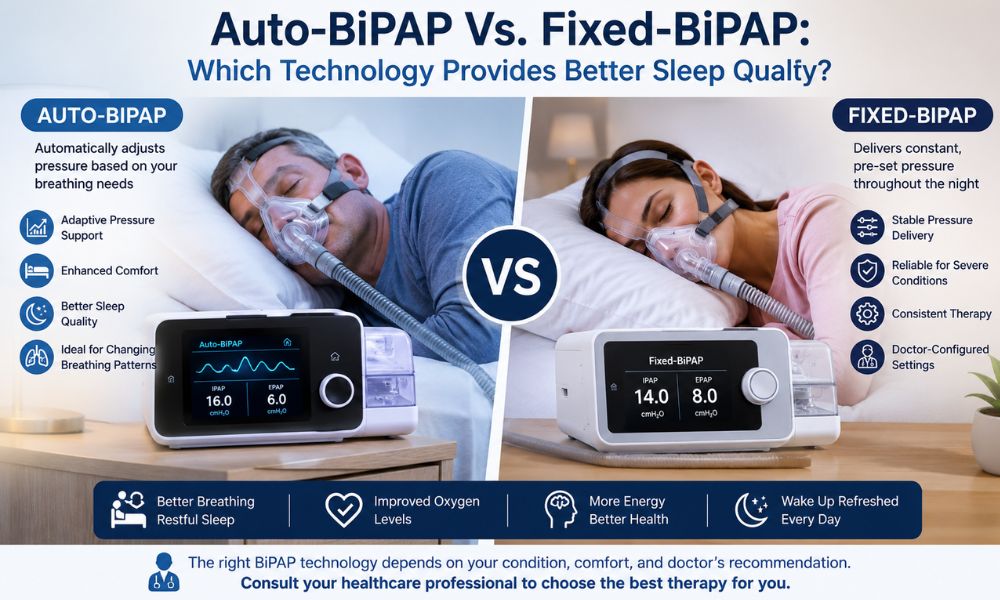
A Fixed-BiPAP machine delivers preset inhalation and exhalation pressure throughout the night. The pressure settings remain constant unless manually adjusted by a doctor or technician.
How It Works
Once the machine is programmed, it continuously provides the same pressure levels every night during therapy.
For example:
- IPAP (Inhalation Pressure): 14 cm H₂O
- EPAP (Exhalation Pressure): 8 cm H₂O
These settings do not automatically change according to breathing patterns.
Benefits of Fixed-BiPAP
Stable Pressure Support
Patients receive consistent therapy throughout sleep.
Suitable for Specific Medical Conditions
Some respiratory conditions require steady and controlled pressure settings.
Simple Technology
Fixed-BiPAP machines are often easier to operate and monitor.
Reliable for Severe Cases
Doctors may prefer fixed pressure for patients with complex respiratory disorders.
Limitations of Fixed-BiPAP
- Pressure may feel uncomfortable during certain sleep stages
- Some patients experience difficulty adapting to fixed airflow
- Changes in body position or breathing patterns are not automatically adjusted
Understanding Auto-BiPAP Technology
An Auto-BiPAP machine automatically adjusts pressure levels according to the patient’s breathing needs during sleep.
It continuously monitors airflow, breathing resistance, and apnea events to provide personalized pressure support.
How It Works
Instead of using fixed pressure, the machine changes inhalation and exhalation pressure throughout the night based on breathing patterns.
If the airway begins to collapse or breathing becomes shallow, the machine increases support automatically. When breathing stabilizes, pressure decreases for improved comfort.
Benefits of Auto-BiPAP
Improved Comfort
Pressure adjusts according to the patient’s real-time breathing needs.
Better Sleep Quality
Many users experience fewer sleep interruptions because airflow feels more natural.
Reduced Pressure Discomfort
The machine avoids delivering unnecessarily high pressure all night.
Adaptive Therapy
Helpful for patients whose breathing changes due to sleeping position, weight changes, or varying sleep stages.
Limitations of Auto-BiPAP
- Usually more expensive than fixed models
- Some patients with severe respiratory conditions may require constant pressure instead
- Requires proper monitoring and setup for best results
Auto-BiPAP Vs. Fixed-BiPAP: Major Differences
| Feature | Auto-BiPAP | Fixed-BiPAP |
|---|---|---|
| Pressure Adjustment | Automatic | Manual/Fixed |
| Comfort Level | Higher for many users | Stable but less flexible |
| Sleep Adaptability | Adjusts during sleep | Same pressure throughout |
| Best For | Changing breathing patterns | Stable respiratory needs |
| Technology | Advanced sensors | Basic pressure system |
| Cost | Higher | More affordable |
Which Technology Provides Better Sleep Quality?
The answer depends on the patient’s medical condition, comfort level, and breathing pattern.
Auto-BiPAP May Be Better For:
- Patients who struggle with fixed pressure discomfort
- Individuals with varying breathing patterns during sleep
- Mild to moderate sleep apnea cases
- Patients seeking more natural airflow support
Because the machine adapts automatically, many users report better comfort and fewer sleep disturbances.
Fixed-BiPAP May Be Better For:
- Patients with severe respiratory disorders
- Individuals requiring stable pressure support
- Cases where doctors recommend controlled settings
- Patients already comfortable with fixed therapy
For these patients, consistent pressure may provide safer and more effective treatment.
Factors That Affect Sleep Quality With BiPAP Therapy
Regardless of machine type, several factors influence therapy success:
Proper Mask Fit
Air leakage can disturb sleep and reduce therapy effectiveness.
Correct Pressure Settings
Improper settings may lead to discomfort or ineffective treatment.
Humidification Support
Heated humidifiers help reduce dryness and irritation.
Regular Machine Maintenance
Clean filters and tubing improve airflow quality and hygiene.
Consistent Usage
Using the machine every night improves long-term sleep quality and health benefits.
Choosing the Right Machine
Patients should never choose a BiPAP machine based only on price or online recommendations. A proper sleep study and medical consultation are important before selecting therapy equipment.
Doctors usually evaluate:
- Breathing patterns
- Oxygen levels
- Severity of sleep apnea
- Existing respiratory conditions
- Comfort requirements
These factors help determine whether Auto-BiPAP or Fixed-BiPAP therapy will provide better results.
Reliable Respiratory Care Support
Choosing the right respiratory equipment is an important part of improving sleep and overall health. My Health Mart offers respiratory care solutions including BiPAP machines, oxygen concentrators, and home healthcare support for patients requiring comfortable and reliable therapy at home.
Conclusion
Both Auto-BiPAP and Fixed-BiPAP machines play an important role in sleep and respiratory therapy. Auto-BiPAP offers greater flexibility and comfort for patients with changing breathing patterns, while Fixed-BiPAP provides stable and controlled pressure support for more specific medical needs.
The best option depends on the patient’s condition, doctor’s recommendation, and comfort during therapy. With proper diagnosis and the right equipment, patients can achieve better sleep quality, improved breathing, and a healthier daily life.
Don’t Miss: When Does a Patient Need a DVT Pump After Hip or Knee Replacement?