If you’ve been diagnosed with central sleep apnea, complex sleep apnea, or severe COPD, you’ve likely moved past the world of standard CPAP machines and into the realm of BiPAP (Bilevel Positive Airway Pressure). But once you arrive here, you face a critical fork in the road: Auto BiPAP vs. Fixed BiPAP.
Choosing between them isn’t just about the price tag or the “fanciness” of the tech; it’s about how your body breathes when you aren’t awake to manage it. This guide breaks down the science, the comfort levels, and the “human factor” to help you decide which technology will actually give you those elusive eight hours of rest.
The Basics: What is BiPAP Anyway?
Before we compare the two, let’s refresh the core tech. Unlike a CPAP, which blows one steady stream of air, a BiPAP uses two distinct pressures:
- IPAP (Inhalation Positive Airway Pressure): A higher pressure when you breathe in to keep the airway open.
- EPAP (Exhalation Positive Airway Pressure): A lower pressure when you breathe out, making it much easier to exhale against the machine.
This “dual-pressure” system is what makes BiPAP a lifesaver for people who find CPAP too restrictive or physically exhausting.
Fixed BiPAP: The Steady Reliable Workhorse
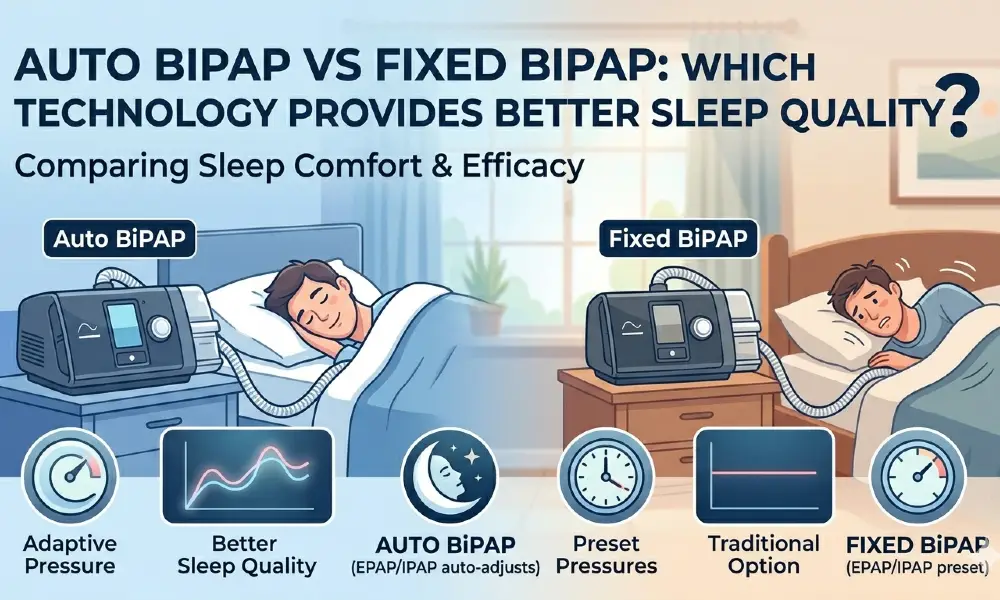
Fixed BiPAP (also known as Manual BiPAP) is the traditional approach. During your sleep study (titration), a technician determines the exact pressure settings you need to keep your airway open. Once set, the machine stays there.
How it Works
If your doctor prescribes an IPAP of 15 and an EPAP of 10, your machine will deliver exactly 15 and 10 all night long, whether you are in a light stage of sleep, deep REM sleep, lying on your side, or flat on your back.
The Pros
- Predictability: Some users find comfort in the rhythm of a constant pressure.
- Price: Generally, fixed units are more budget-friendly than their “Auto” counterparts.
- Clinical Precision: For certain medical conditions, doctors prefer a “set it and forget it” approach to ensure the lungs are getting a specific volume of air.
The Cons
- The “Over-Pressure” Problem: If you only need high pressure when you’re on your back, a fixed machine will still blast you with that high pressure when you’re on your side (when you might need much less).
- Changing Needs: If you lose weight, gain weight, or have a glass of wine before bed, your pressure needs change. With a fixed machine, you have to go back to the doctor to get the settings adjusted.
Auto BiPAP: The Smart Sleeper
Auto BiPAP (often called ABPAP or Auto-Bilevel) is the “smart” evolution of the technology. These machines use complex algorithms to monitor your breathing breath-by-breath.
How it Works
Instead of one fixed number, your doctor sets a pressure range (e.g., IPAP range of 10-20). The machine “listens” for snoring, flow limitations, or apneas. If it senses an obstruction, it nudges the pressure up. When things are clear, it drifts back down to a more comfortable, lower setting.
The Pros
- Variable Comfort: It provides the minimum amount of pressure necessary at any given moment. This often leads to fewer mask leaks and less “aerophagia” (swallowing air).
- Adapts to Life: If you have allergies one night or are extra tired another, the machine adjusts automatically. No need for constant clinical re-titrations.
- Lower Average Pressure: Most users on Auto BiPAP find that their average pressure throughout the night is significantly lower than their fixed prescription.
The Cons
- The “Hunting” Effect: Occasionally, very sensitive sleepers might wake up because they feel the machine “searching” for the right pressure or ramping up too quickly.
- Cost: The advanced sensors and algorithms make these units more expensive.
Head-to-Head: Impact on Sleep Quality
When we talk about “Sleep Quality,” we aren’t just talking about staying asleep; we’re talking about the architecture of your sleep.
| Feature | Fixed BiPAP | Auto BiPAP |
|---|---|---|
| Ease of Exhalation | Good (Fixed EPAP) | Excellent (Adjustable EPAP) |
| Adaptability | Low | High |
| Mask Leak Risk | Higher (at high fixed pressures) | Lower (adjusts to seal) |
| Ideal For | Chronic Lung Disease / Stable Needs | OSA / Fluctuating Pressure Needs |
| Cost | ₹₹₹ | ₹₹₹–₹₹₹₹ |
Why Auto BiPAP Often Wins on Comfort?
For many, the biggest barrier to sleep quality is mask discomfort. High pressure can break the seal of a mask, causing air to hiss into your eyes or create loud noises that wake you up. Because an Auto BiPAP spends much of the night at a lower pressure, the mask seal is easier to maintain, leading to fewer “micro-awakenings.”
Why Fixed BiPAP Wins on Stability?
For patients with restrictive lung diseases or certain neuromuscular disorders, the goal isn’t just to keep the airway open; it’s to ensure the lungs expand fully. In these cases, the “fluctuating” nature of an Auto machine can actually be counterproductive. A fixed, steady pressure ensures the body knows exactly what to expect every time the diaphragm moves.
Which One is Right for You?
Choosing between these two isn’t about which tech is “better” in a vacuum; it’s about your specific biology.
Choose Fixed BiPAP if:
- You have a stable condition: Your sleep apnea doesn’t change much regardless of your position or sleep stage.
- You are on a budget: You want effective treatment without the bells and whistles.
- You have specific lung requirements: Your doctor has expressed that “pressure support” must remain constant to manage CO2 levels.
Choose Auto BiPAP if:
- You are a “positional” sleeper: You only have severe apnea when lying on your back.
- You struggle with high pressure: You find it hard to tolerate the “blast” of air needed to clear your worst apneas when they aren’t actually happening.
- You want “future-proofing“: You want a machine that adapts as you age, change weight, or change health status.
The Verdict: The Role of Technology in Sleep
At the end of the day, Auto BiPAP technology generally provides better sleep quality for the average user because it prioritizes comfort and reduces the side effects of high-pressure therapy. By tailoring the pressure to the immediate needs of your airway, it mimics natural breathing more closely than a fixed machine ever could.
However, “better” is subjective in medicine. The most expensive Auto BiPAP in the world is useless if the algorithm interferes with your specific breathing pattern.
A Pro Tip for New Users
Many Auto BiPAP machines can actually be set to “Fixed Mode.” If you aren’t sure which you need, buying an Auto machine gives you the flexibility to try both. You can start in Auto mode, and if you find the pressure fluctuations distracting, your therapist can switch it to a fixed setting with a few clicks.
Wrapping Up
Sleep is the foundation of your health, affecting everything from heart function to mental clarity. While Auto BiPAP offers a more “human-centric” and adaptive experience, the best technology is the one that you will actually wear every night.
If you find yourself constantly ripping your mask off at 3:00 AM, it might be time to talk to your doctor about switching from Fixed to Auto. Conversely, if you feel like you aren’t catching your breath on an Auto setting, a Fixed pressure might provide the stability your lungs crave.
Don’t Miss: Why is My Oxygen Concentrator Beeping? Common Alarms Explained