
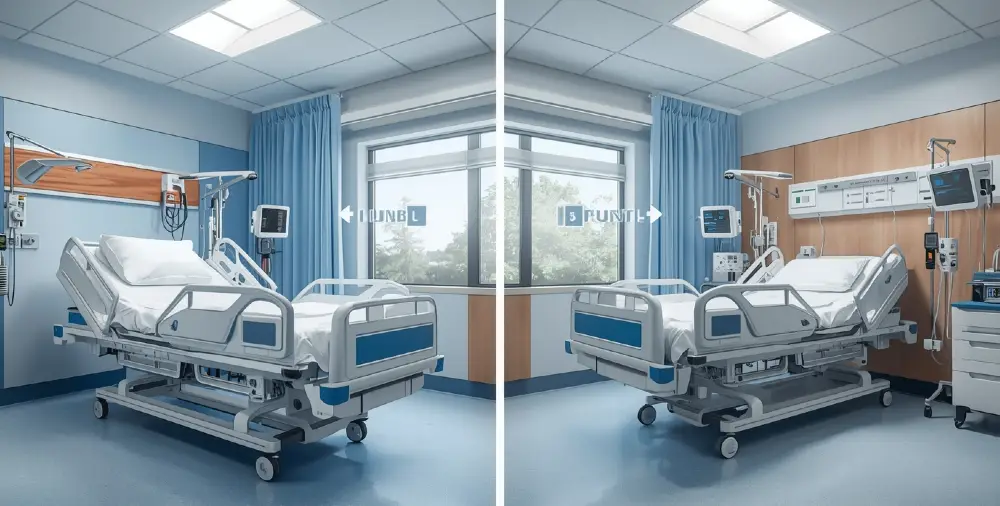
Medical technology has advanced to a point where “one size fits all” no longer applies to patient care, especially in critical care environments. When setting up an Intensive Care Unit (ICU) or arranging for high-level home care, the choice of equipment can directly impact patient recovery and the efficiency of the nursing staff.
Among the most vital pieces of equipment is the ICU bed. While they may look similar to the untrained eye, the mechanical capabilities, specifically the “functions”, are what define their utility. Generally, the choice often boils down to two industry standards: the 3-Function and the 5-Function ICU bed.
This guide provides an in-depth exploration of the technical differences, clinical benefits, and practical applications of both.
Understanding the “Function” in Medical Beds
Before diving into the comparison, it is essential to define what a “function” actually is in this context. A function refers to a motorized movement or adjustment that the bed can perform. These are typically controlled by a remote handset, a nurse control panel at the footboard, or built-in side-rail buttons.
The goal of these functions is twofold:
- Patient Comfort and Safety: To prevent pressure sores, assist in breathing, and improve circulation.
- Caregiver Ergonomics: To allow doctors and nurses to perform procedures without straining their backs or risking patient falls.
What is a 3-Function ICU Bed?
A 3-function bed is often considered the “standard” for semi-critical care or stable ICU patients. It provides the essential movements required to keep a patient upright and comfortable.
The Three Core Movements:
Backrest Adjustment: Allows the upper body to be raised (usually up to 70°–80°). This is crucial for patients who need to sit up to eat, breathe more easily (preventing pulmonary congestion), or interact with visitors.
Knee Rest (Leg) Adjustment: Raises the lower half of the legs. This prevents the patient from sliding down the bed when the backrest is raised and helps in maintaining proper blood flow in the lower extremities.
- Height Adjustment (Hi-Lo): This allows the entire bed platform to move vertically up and down.
- Low position: Safest for patients getting in or out of bed.
- High position: Essential for caregivers to provide treatment at waist height, preventing chronic back injuries.
What is a 5-Function ICU Bed?
A 5-function bed is a sophisticated piece of medical machinery designed for patients with high dependency or those who are completely immobile. It includes all the movements of a 3-function bed but adds two critical “tilting” capabilities.
The Additional Two Movements:
- Trendelenburg Position: The bed is tilted so that the head is lower than the feet (typically by 12°–15°).
Clinical Use: This is used in emergencies to treat hypotension (low blood pressure) or to assist in certain surgical/imaging procedures.
- Reverse Trendelenburg Position: The bed tilts so that the feet are lower than the head.
Clinical Use: This is vital for patients with respiratory distress, as it uses gravity to shift abdominal organs away from the diaphragm. It is also used to reduce acid reflux and to lower intracranial pressure in patients with head injuries.
Detailed Comparison: 3-Function vs. 5-Function
| Feature | 3-Function Bed | 5-Function Bed |
|---|---|---|
| Backrest Lift | Yes | Yes |
| Knee Rest Lift | Yes | Yes |
| Vertical Height Adjustment | Yes | Yes |
| Trendelenburg | No | Yes |
| Reverse Trendelenburg | No | Yes |
| Primary Setting | Semi-ICU, Wards, Home Care | Critical ICU, Cardiac Units, Post-Op |
| Patient Mobility | Semi-mobile or stable | Completely immobile / Critically ill |
| Price Point | Mid-Range | High-End |
Why the Extra Functions Matter: The Clinical Perspective
You might wonder if two extra tilting functions really justify the higher cost of a 5-function bed. In a critical care setting, the answer is often a resounding yes.
1. Pressure Ulcer Prevention: Patients in the ICU are at high risk for “bedsores.” A 5-function bed supports “Cardiac Chair” positioning, combining backrest elevation with Reverse Trendelenburg. This redistributes the patient’s weight more effectively than a standard 3-function bed, significantly reducing pressure on the sacrum and heels.
2. Respiratory Support: For patients on ventilators, the angle of the bed is a matter of life and death. The 5-function bed allows for precise tilting to optimize lung expansion. The Reverse Trendelenburg position is particularly helpful for patients with Ventilator-Associated Pneumonia (VAP).
3. Circulatory Stability: If a patient’s blood pressure suddenly drops, a 5-function bed can be switched to the Trendelenburg position in seconds. This allows blood to flow back toward the brain and heart, providing a vital bridge until medication or other interventions can take effect.
Design and Safety Features
Regardless of the functions, high-quality ICU beds share several physical characteristics designed for the rigors of a hospital:
- Toughened Frames: Usually made of epoxy-powder-coated steel to resist corrosion and heavy cleaning chemicals.
- Split Side Rails: Prevent patients from falling while still allowing them a handhold if they try to reposition themselves.
- Central Braking Systems: A single pedal that locks all four wheels simultaneously—essential during emergencies.
- CPR Release: A manual lever that instantly flattens the backrest. You cannot wait for a slow motor to lower the backrest if a patient goes into cardiac arrest.
- X-Ray Translucent Backrest: Many 5-function beds allow X-ray plates to be inserted behind the patient so they don’t have to be moved for chest films.
Choosing the Right Bed for Home Care
If you are looking for an ICU bed for home use, the decision is usually based on the patient’s prognosis.
- Choose a 3-Function Bed if: The patient is recovering from a stroke or surgery but is generally stable. If they can sit up and there is no immediate risk of severe respiratory or blood pressure fluctuations, the 3-function bed provides excellent value and comfort.
- Choose a 5-Function Bed if: The patient is comatose, paralyzed, or has severe chronic respiratory issues. If the patient will be in bed 24/7 for the foreseeable future, the tilting functions are necessary to prevent long-term complications like pneumonia and deep vein thrombosis (DVT).
Maintenance and Longevity
Because these beds rely on linear actuators (motors), they require maintenance.
- Battery Backup: Ensure the bed has a battery backup. A 5-function bed is useless in a power cut if it’s stuck in a tilted position.
- Load Capacity: Always check the “Safe Working Load” (SWL). Most ICU beds are rated for 200kg to 250kg.
- Sanitization: The panels and mattresses should be seamless to prevent bacteria from hiding in crevices.
Wrapping Up
The difference between a 3-function and a 5-function ICU bed is the difference between standard support and comprehensive critical care. While the 3-function bed covers the basics of elevation and height, the 5-function bed provides the specialized tilting necessary to manage complex medical emergencies and long-term immobility.
Investing in the right bed is not just about the equipment; it’s about providing the patient with the best possible environment for healing and giving the caregiver the tools they need to work safely.
Don’t Miss: Top 10 Home ICU Setup Companies in Delhi