Oxygen concentrators have become an essential part of home and hospital care for patients with breathing difficulties. Whether it is for long-term respiratory conditions, post-COVID recovery, or emergency oxygen support, choosing the right oxygen concentrator plays a critical role in patient comfort and recovery.
One of the most common questions people ask is whether they need a 5 LPM or a 10 LPM oxygen concentrator. While both serve the same purpose, they are designed for different oxygen requirements. Understanding the difference between them helps ensure the patient receives the correct amount of oxygen safely and effectively.
This guide explains the differences, use cases, advantages, and practical considerations to help you choose the right oxygen concentrator.
Understanding Oxygen Flow Rate (LPM)
LPM stands for Liters Per Minute. It indicates how much oxygen a concentrator can deliver to a patient every minute. A higher LPM means more oxygen is supplied.
A 5 LPM concentrator can deliver up to five liters of oxygen per minute, while a 10 LPM concentrator can deliver up to ten liters per minute. The required flow rate is determined by a doctor based on the patient’s oxygen saturation level, lung condition, and overall health.
Oxygen concentrators take in room air, remove nitrogen, and deliver concentrated oxygen, usually at a purity level of around 93 percent. This makes them a reliable alternative to oxygen cylinders for continuous oxygen therapy.
5 LPM Oxygen Concentrator: Who Is It For?
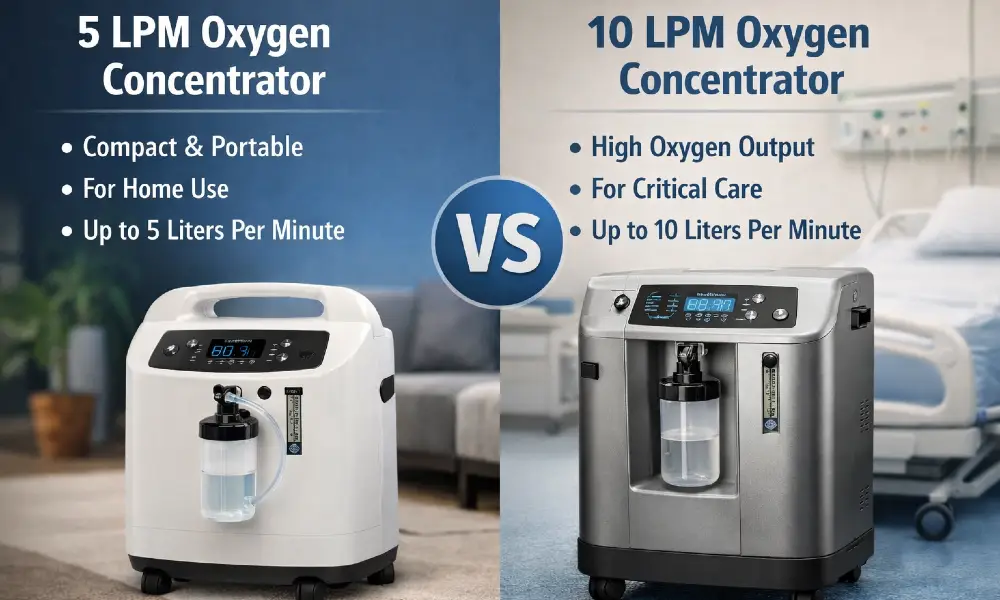
A 5 LPM oxygen concentrator is the most commonly used model for home oxygen therapy. It is designed for patients who need low to moderate oxygen support regularly.
This type of concentrator is compact, lightweight, and consumes less electricity. It is easy to move within the house and does not require special installation. Because of its size and efficiency, it is ideal for elderly patients and long-term home users.
A 5 LPM concentrator is suitable for patients with:
- Mild to moderate COPD
- Post-COVID breathing weakness
- Asthma-related breathing difficulty
- Sleep-related oxygen therapy
- Recovery phase lung support
Most patients who require oxygen only while resting, sleeping, or doing light activities can comfortably manage with a 5 LPM machine.
The lower purchase and rental cost also make it an affordable option for families who need oxygen therapy for several months.
10 LPM Oxygen Concentrator: Who Needs It?
A 10 LPM oxygen concentrator is designed for patients who require a higher flow of oxygen. It is more powerful, larger in size, and built for continuous heavy-duty usage.
This model is usually recommended for patients with serious lung conditions or those who need oxygen even during physical movement. It is commonly used in hospitals, nursing homes, and ICU step-down care.
A 10 LPM concentrator is suitable for patients with:
- Severe COPD or emphysema
- Pulmonary fibrosis
- Advanced pneumonia
- Critical post-surgery recovery
- Low oxygen saturation that does not improve with 5 LPM
Because of its higher output, it is also used in hospital wards where one machine may support more than one patient at lower flow rates.
Key Differences Between 5 LPM and 10 LPM Oxygen Concentrators
The main difference between these two machines is their oxygen output capacity.
A 5 LPM concentrator delivers oxygen up to five liters per minute and is ideal for mild to moderate respiratory needs. It is quieter, consumes less electricity, costs less, and is easier to move.
A 10 LPM concentrator delivers oxygen up to ten liters per minute and is suitable for patients with higher oxygen demands. It is more powerful, larger in size, and consumes more electricity. It is designed for continuous heavy usage.
In simple terms, a 5 LPM concentrator is best for home use, while a 10 LPM concentrator is best for hospital-level care or patients with severe breathing problems.
How Doctors Decide the Required Flow Rate?
Doctors usually prescribe oxygen therapy after checking the patient’s blood oxygen saturation level using a pulse oximeter. A healthy oxygen saturation level usually ranges from 95% to 100%.
If oxygen levels fall below 90 percent, oxygen therapy may be recommended. The flow rate is then adjusted based on how well the patient responds.
Patients with oxygen levels between 88 and 92 percent often require 2 to 5 LPM. Patients with oxygen levels below 85 percent may require higher flow rates such as 8 to 10 LPM.
The required flow may also increase during physical activity, walking, or physiotherapy. This is why some patients need a higher-capacity concentrator even if their resting oxygen level seems stable.
It is important not to self-prescribe oxygen flow. Too little oxygen is dangerous, and too much oxygen can also cause complications, especially for COPD patients
Cost and Power Consumption
A 5 LPM oxygen concentrator is more affordable to buy or rent. It also consumes less electricity, making it suitable for long-term daily use at home.
A 10 LPM concentrator costs more because of its larger compressor, stronger motor, and higher oxygen output. It also consumes more power and may slightly increase electricity bills.
However, for patients who genuinely need higher oxygen support, the higher cost is justified for safety and health.
Portability and Ease of Use
Most 5 LPM concentrators come with wheels and handles, making them easy to move from one room to another. They are quieter and more comfortable for nighttime use.
10 LPM concentrators are heavier and bulkier. They are usually kept in one fixed place and require good ventilation around the machine for proper airflow.
Both machines are simple to operate and come with digital displays, alarms, and safety features.
Safety and Maintenance
Regardless of the model, basic safety rules should always be followed:
- Keep the machine in a well-ventilated room
- Do not smoke near oxygen equipment
- Place the machine away from heat sources and open flames.
- Clean air filters regularly
- Use only the prescribed oxygen flow
Regular servicing ensures better performance and longer machine life.
Which One Should You Choose?
If your doctor has prescribed oxygen flow up to 5 liters per minute, a 5 LPM oxygen concentrator is the right choice. It is economical, compact, and perfect for home use.
If your doctor has prescribed more than 5 liters per minute or if your oxygen level drops significantly during activity, a 10 LPM concentrator is the safer option.
The right concentrator is not about buying the biggest machine, but about choosing the one that matches the patient’s medical needs.
My Health Mart
My Health Mart provides reliable oxygen concentrator rental services in Delhi for home and medical use. We offer high-quality 5 LPM and 10 LPM oxygen concentrators with fast doorstep delivery, easy installation, and full technical support. Our machines are well-maintained, hygienic, and ready for immediate use, ensuring safe and continuous oxygen therapy for patients.
Whether you need oxygen support for recovery, elderly care, or long-term respiratory conditions, My Health Mart ensures affordable rental plans with dependable service. Trusted by families and healthcare professionals, we are committed to delivering comfort, care, and peace of mind.
Final Thoughts
Both 5 LPM and 10 LPM oxygen concentrators play a vital role in modern respiratory care. The correct choice ensures proper oxygen delivery, better comfort, and improved quality of life.
A 5 LPM concentrator is ideal for most home users with mild to moderate conditions, while a 10 LPM concentrator is designed for patients who require higher oxygen support or hospital-level care.
Always consult a healthcare professional before choosing an oxygen concentrator. The right machine can make a significant difference in recovery, safety, and long-term health.
Don’t Miss: What is the Biggest Cause of Sleep Apnea?